

Is coconut oil good for your hair, or is it just another overhyped beauty trend?
The short answer: Yes—but only if you use it correctly and if it suits your hair type.
Coconut oil is one of the few natural oils proven to penetrate the hair shaft, reduce protein loss, and protect against damage. However, using it the wrong way can actually make your hair dry, brittle, or greasy.
At Fattah Primary Care, we often see patients dealing with scalp irritation, hair thinning, and buildup issues caused by improper hair care routines—not just underlying conditions.
What Are the Benefits of Coconut Oil for Hair?
✔ Protein Loss Reduction (Scientifically Proven)
Coconut oil contains lauric acid, which penetrates deep into the hair shaft.
👉 Result:
- Less breakage
- Stronger strands
- Better length retention
✔ Frizz & Moisture Control
It forms a protective layer that:
- Locks in moisture
- Reduces humidity damage
- Improves shine
✔ Scalp Health Support
Coconut oil has mild antifungal properties, which may help with dandruff caused by yeast.
However, if you have persistent itching or flakes, it may be linked to conditions like:
- scalp infections
- dermatitis
In such cases, professional care like Allergic Reaction or skin-related treatment is more effective than home remedies.
Is Coconut Oil Good for Hair Growth?
No peer-reviewed clinical trial has confirmed that coconut oil directly stimulates new follicle activity or accelerates the anagen (growth) phase. Hair growth is primarily governed by genetics, hormonal signaling (DHT, estrogen), thyroid function, and nutrition, not topical oils.
Where coconut oil does contribute to perceived growth is through breakage reduction. If your hair is breaking at a rate that outpaces growth, your length will stagnate. By decreasing protein loss and mechanical damage, coconut oil helps retain the length that is already growing, making it appear to grow faster. This is a meaningful distinction for anyone frustrated by length plateaus.
How to Use Coconut Oil for Hair?
Application method matters as much as the oil itself. The right technique determines whether coconut oil works for or against your hair.
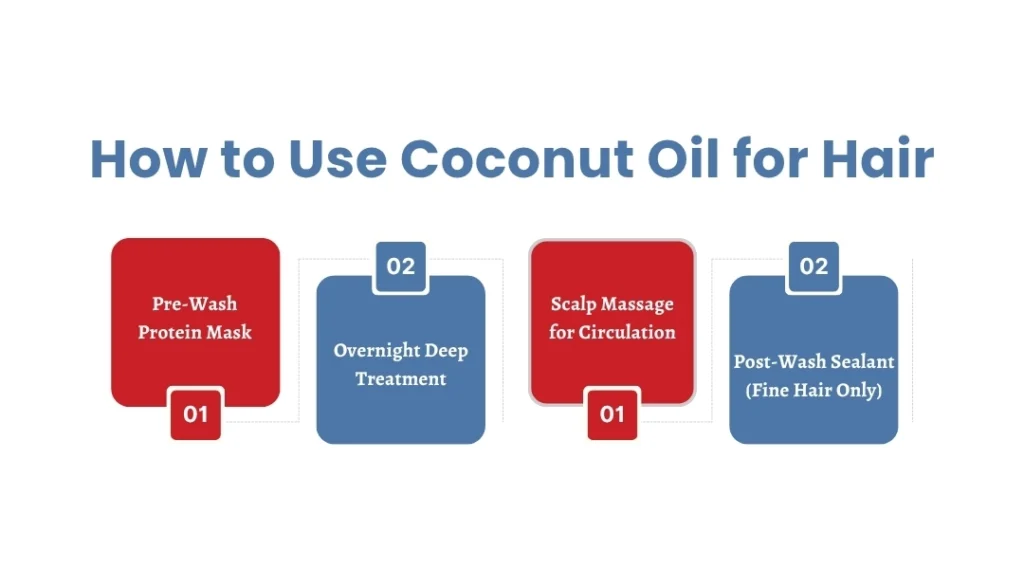
1. Pre-Wash Protein Mask
Apply 1–2 tablespoons of virgin coconut oil to dry hair 30–60 minutes before shampooing. Focus on mid-lengths and ends of the oldest, most porous sections. Cover with a shower cap to generate mild heat. The pre-wash timing is critical: protein-bound coconut oil is rinsed away before it can block moisture absorption post-wash.
2. Overnight Deep Treatment
For high-porosity or chemically damaged hair, apply generously from root to tip the night before wash day. Wear a silk or satin cap to avoid pillowcase transfer. The extended contact time allows maximum cortex penetration. Rinse thoroughly in the morning. Residue causes greasiness.
3. Scalp Massage for Circulation
Warm 1 teaspoon between palms (not microwave, uneven heating degrades antioxidants) and massage into the scalp using fingertip pressure for 4–5 minutes. This stimulates blood flow to follicles. Limit scalp application to those without seborrheic dermatitis, as oil can worsen certain scalp conditions.
In such cases, clinical care like Skin Rash Treatment or Infection Treatment is more appropriate.
4. Post-Wash Sealant (Fine Hair Only)
A very small amount (smaller than a pea) smoothed onto damp ends seals the cuticle without weighing down the strand. Fine hair should be used sparingly or avoided entirely, as the molecular weight is light enough, but accumulation over multiple uses leads to buildup.
What to Mix With Coconut Oil for Hair Growth
Coconut oil works best as a carrier; it enhances the delivery of other actives into the hair shaft and scalp. These are the evidence-supported combinations:
| Add-In | Ratio toCoconut Oil | Mechanism | Best For |
| Rosemary Essential Oil | 2–3 drops pertbsp | Inhibits 5-alpha reductase;improves scalp circulation | DHT-related thinning |
| Castor Oil | 1:1 ratio | Ricinoleic acid reduces scalpinflammation; lubricates the cuticle | Breakage & dryness |
| Amla (IndianGooseberry) | 1 tsp powder pertbsp | Vitamin C boosts collagen aroundfollicle base | Premature greying &weak hair |
| Fenugreek Paste | 1 tsp per 2 tbsp | Nicotinic acid improves the scalpblood flow; lecithin conditions | Shedding & scalphealth |
| Argan Oil | 1:1 ratio | Tocopherols protect againstoxidative follicle damage | Color-treated &sun-exposed hair |
How Often Should You Use Coconut Oil?
| Hair Type | Recommended Frequency | Method |
| Fine / Low Porosity | Once every 2–3 weeks | Pre-wash ends only; rinsethoroughly |
| Medium / Normal | Once per week | Pre-wash mask, 30–60 min |
| Thick / High Porosity | 1–2 times per week | Overnight treatment + pre-wash |
| Coily / Curly (4A–4C) | 1–2 times per week | LOC method: liquid, oil, cream |
| Color / Chemically Treated | Every 5–7 days | Pre-color treatment to reduce dyedamage |
Does Coconut Oil Have Any Negative Effects on Hair?
Coconut oil is not universally beneficial. Knowing when it works against your hair is as important as
knowing when it helps.
■ Low Porosity Hair Paradox
If your hair cuticle lies flat and tightly sealed (low porosity), coconut oil cannot penetrate efficiently and instead coats the surface. This creates a protein-blocking layer that prevents moisture from entering, leaving hair brittle and straw-like. Test: Does your hair take forever to get wet in the shower? Coconut oil may not be your friend.
■ Protein Sensitivity
Some individuals, particularly those with fine or chemically over-processed hair, develop protein sensitivity. Excess protein (which coconut oil helps retain) leads to stiff, snapping hair with no elasticity. If your hair breaks easily when wet, pause coconut oil and focus on moisture-first conditioning.
■ Scalp Buildup & Follicle Blockage
Coconut oil is comedogenic (pore-clogging) on some scalp types. Heavy or frequent application can trap dead skin, increase dandruff-like symptoms, and create a follicle environment that impedes healthy growth, the opposite of the intended effect.
■ Contact Dermatitis
True coconut oil allergy is rare but real. If you notice redness, itching, or hive-like reactions after application, discontinue immediately and seek a clinical evaluation. Cross-reactivity with tree nut allergies is documented in a small subset of individuals.
Final Thoughts
Coconut oil is not a miracle cure, but it is far from a myth. When used correctly and matched to your hair type, it can significantly reduce protein loss, improve manageability, and protect your hair from everyday damage. The key lies in understanding its limitations as much as its benefits, especially when it comes to growth expectations and scalp compatibility.
Healthy hair reflects overall health, not just what you apply topically. If coconut oil isn’t working for you or you have ongoing scalp concerns, seek personalized medical guidance. Visit Fattah Primary Care to explore evidence-based care and expert support tailored to your needs.
FAQs
Q1. Can I use coconut oil on my hair every day?
Yes, you can use coconut oil on your hair every day, but it’s not recommended for most people.
Q2. Can coconut oil help with an itchy scalp?
Coconut oil may provide temporary relief from itchiness due to its moisturizing and mild antimicrobial properties, but it won’t treat underlying conditions like eczema or psoriasis.
Q3. Is coconut oil safe for colored or bleached hair?
Yes, when used as a pre-wash treatment, it can help reduce damage and dryness caused by chemical processing, but overuse may lead to buildup and dullness.
Q4. Can coconut oil replace conditioner?
Not entirely. Coconut oil lacks the conditioning agents found in formulated products, so it’s best used alongside a regular conditioner rather than as a complete substitute.
Q5. Does coconut oil protect hair from chlorine or salt water?
Applying a small amount before swimming can create a light barrier that reduces water absorption and potential damage, though it won’t fully prevent it.
Q6. Can coconut oil make hair greasy or heavy?
Yes, especially for fine or low-porosity hair. Using too much or not washing it out properly can leave hair limp, greasy, and weighed down.
Q7. Is there a best time to apply coconut oil to hair?
Pre-wash application is generally most effective, as it allows penetration while avoiding post-wash buildup that can interfere with moisture balance.