If your last blood panel showed low vitamin D and high cholesterol on the same page, you’re not imagining a coincidence. Doctors and researchers have spent the past decade studying exactly this pairing, and while the science isn’t 100% settled, the data points in a consistent direction: people with low vitamin D levels tend to have less favorable cholesterol numbers.
That doesn’t automatically mean one causes the other, but it does mean the two deserve to be looked at together, especially if you’re managing your heart health in Spring, TX or anywhere else.
You will get to know what the research actually says, how vitamin D may influence cholesterol metabolism, the warning signs of a deficiency, and when it’s time to get both levels checked by a primary care provider.
Can Low Vitamin D Cause High Cholesterol?
Most large studies find a clear association between low vitamin D and an unhealthy lipid profile, meaning higher LDL (“bad” cholesterol), higher triglycerides, and lower HDL (“good” cholesterol). However, association is not the same as proof of direct cause. Here’s how the current evidence breaks down:
| Research Finding | What It Suggests |
| Large observational studies (10,000+ people) | Low vitamin D is consistently linked to a higher total cholesterol-to-HDL ratio |
| Studies on small dense LDL particles | Vitamin D deficiency is associated with the more artery-damaging type of LDL |
| Vitamin D receptor research | Vitamin D receptors exist on cells involved in fat and cholesterol metabolism |
| Supplementation trials | Results are mixed; correcting a deficiency helps some people’s lipid panel, but not everyone’s |
| Statin-vitamin D interaction studies | Some cholesterol medications may affect how the body processes vitamin D, and vice versa |
Is There a Link Between Vitamin D and Cholesterol?
Yes, but it’s a two-way, complicated relationship rather than a simple domino effect. Cholesterol is actually the raw material your skin uses to make vitamin D when exposed to sunlight. So on one hand, cholesterol is necessary for vitamin D production. On the other hand, several studies have found that when vitamin D is deficient, cholesterol levels tend to drift in the wrong direction, with more LDL and triglycerides and less protective HDL.
One 2023 study of more than 15,000 people found that participants with lower vitamin D levels were significantly more likely to have high cholesterol. Similarly, research published in the Journal of Clinical Lipidology found that vitamin D deficiency was associated with an “atherogenic” lipid profile, meaning one that raises cardiovascular risk. Researchers are still working out exactly how much of this is cause-and-effect versus shared risk factors like obesity, low physical activity, and limited sun exposure, all of which independently affect both vitamin D and cholesterol.
How Does Vitamin D Affect Cholesterol?
Scientists have proposed several biological mechanisms that could explain the connection:
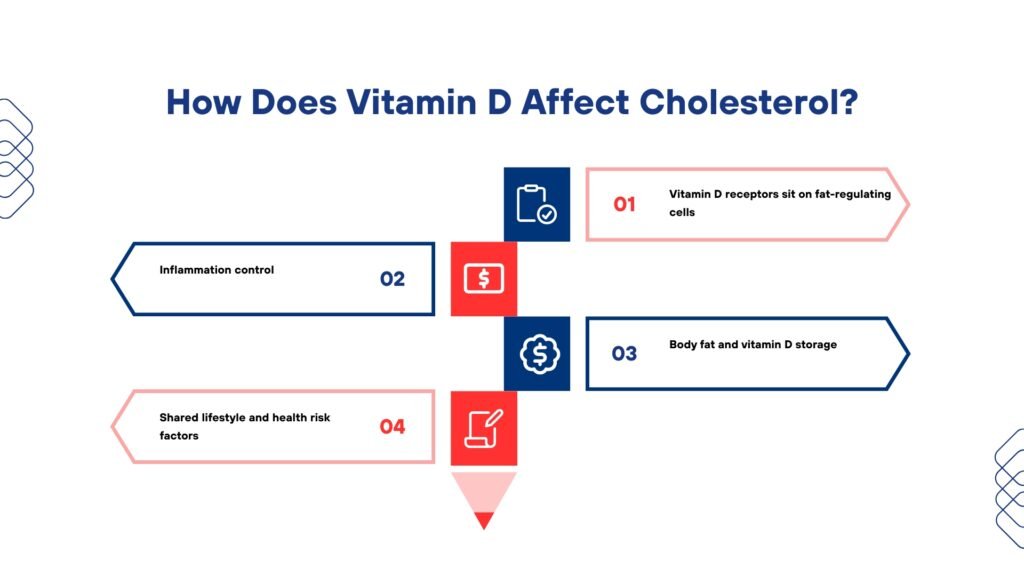
1. Vitamin D receptors sit on fat-regulating cells
Vitamin D receptors are found on cells throughout the body, including those involved in processing and storing fat. When vitamin D is low, these cells may not regulate lipid metabolism as efficiently, which can allow LDL and triglycerides to climb.
2. Inflammation control
Vitamin D helps regulate inflammation throughout the body. Chronic low-grade inflammation is closely tied to unhealthy cholesterol patterns and to the buildup of plaque inside artery walls, so a deficiency may indirectly worsen your lipid profile.
3. Body fat and vitamin D storage
Vitamin D is fat-soluble, meaning it gets stored in fat tissue rather than circulating freely in the blood. People with higher body fat often have lower measurable vitamin D levels because more of it is “locked away” in fat cells, and higher body fat is also independently linked to higher cholesterol. This overlap makes it hard to separate cause from coincidence.
4. Shared lifestyle and health risk factors
Limited sun exposure, sedentary habits, and poor diet can lower vitamin D and worsen cholesterol at the same time, without one directly causing the other. This is why doctors look at the full picture, not just one number, during a physical exam.
What Causes Low Vitamin D and High Cholesterol?
Several overlapping causes can push both numbers in the wrong direction at once:
| Cause | Effect on Vitamin D | Effect on Cholesterol |
| Limited sun exposure / indoor lifestyle | Lowers natural vitamin D synthesis | Linked to reduced physical activity, which can raise LDL |
| Obesity or higher body fat percentage | Vitamin D gets stored in fat tissue, lowering blood levels | Associated with higher LDL, triglycerides, lower HDL |
| Poor diet (low in fatty fish, fortified foods, fiber) | Fewer dietary vitamin D sources | Higher saturated fat intake raises LDL |
| Sedentary lifestyle | Less outdoor activity means less sun exposure | Lower HDL, higher triglycerides |
| Aging | Skin becomes less efficient at producing vitamin D | Cholesterol often rises naturally with age |
| Certain medical conditions (kidney or liver disease, malabsorption disorders) | Impairs vitamin D conversion or absorption | Can disrupt normal lipid processing |
Of these, body weight is one of the few factors you have real control over. If excess weight is contributing to both your low vitamin D and elevated cholesterol, our Weight Loss Management program can help you address the root cause with a structured, medically supervised plan, rather than treating the two numbers separately.
Can Vitamin D Help Lower Cholesterol?
This is the question most patients actually want answered, and the honest response is: maybe, but not on its own. Here’s what the research shows about vitamin D supplementation and cholesterol:
- Some studies suggest correcting a vitamin D deficiency modestly increases HDL (“good” cholesterol) and lowers LDL (“bad” cholesterol) in certain people.
- Other well-designed trials have found no significant change in lipid panels after supplementation, meaning results are inconsistent.
- Vitamin D supplements are not a replacement for cholesterol-lowering medication when LDL is significantly elevated.
- If you’re on a statin, be cautious with high-dose vitamin D supplements, since both are processed by similar liver enzymes and can interact.
- The strongest evidence supports treating a vitamin D deficiency as part of a broader cardiovascular wellness plan, not as a stand-alone cholesterol treatment.
Don’t expect a vitamin D pill to replace diet changes, exercise, or prescribed medication. Think of it as one piece of a larger puzzle that your primary care provider can help you assemble.
What Are the Signs of Low Vitamin D?
Vitamin D deficiency is famously sneaky. Many people have no obvious symptoms at all, which is exactly why routine screening matters. When symptoms do appear, they tend to be nonspecific and easy to blame on stress, aging, or lack of sleep.
- Persistent fatigue that doesn’t improve with rest
- Bone pain or general aching, especially in the lower back and legs
- Muscle weakness, cramps, or reduced strength
- Mood changes, including low mood, anxiety, or irritability
- Frequent illness or a weakened immune response
- Slow wound healing
- Hair thinning in more severe or prolonged deficiency
Because these signs overlap with dozens of other conditions, the only reliable way to confirm a deficiency is a simple blood test measuring 25-hydroxyvitamin D.’
When Should You Get Your Vitamin D and Cholesterol Checked?
Both vitamin D and cholesterol are typically checked with simple blood tests, often during the same annual visit. Here’s a general guide for how often screening is recommended:
| Test | General Recommendation | Consider Earlier / More Often If |
| Vitamin D (25-hydroxyvitamin D) | As part of an annual physical, or if symptoms appear | You have limited sun exposure, darker skin, obesity, or a malabsorption condition |
| Cholesterol / Lipid Panel | Every 4–6 years for healthy adults starting around age 20 | You have a family history of heart disease, diabetes, high blood pressure, or are over 40 |
| Both together | Recommended if either result is abnormal or borderline | You’re managing a chronic condition or starting a new medication that affects lipids |
If you’ve never had either test, or it’s been more than a year, a same-day or next-day visit with a primary care provider is the easiest way to get both drawn at once and reviewed together, rather than treating them as unrelated numbers.
What You Can Do If Both Levels Are Off
If your results come back showing low vitamin D alongside elevated cholesterol, a reasonable, evidence-based plan usually includes:
- Get both levels confirmed with a blood test rather than guessing based on symptoms alone.
- Discuss targeted vitamin D supplementation with your provider, since dosing depends on how low your levels are.
- Increase safe sun exposure and vitamin D-rich foods like fatty fish, egg yolks, and fortified dairy.
- Address modifiable lifestyle factors together, including weight, activity level, and diet, since they influence both numbers.
- Recheck both levels after 3 to 6 months to see whether your plan is actually working.
- If cholesterol remains high despite lifestyle changes, ask about medication options, since vitamin D correction alone is often not enough.
The Bottom Line
Low vitamin D and high cholesterol show up together often enough that they’re worth checking as a pair, not in isolation. The science doesn’t yet prove that one directly causes the other, but the overlap in biology and lifestyle factors is strong enough that most primary care providers will look at both when reviewing your annual labs.
Fattah Primary Care in Spring, TX offers same-day and next-day appointments for full lab work, including vitamin D and cholesterol screening, as part of our Men’s Physical Exam and Women’s Physical visits. If you’d like personalized guidance on managing your cholesterol and vitamin D levels together, schedule a visit with our care team today.