A new patch of red, itchy skin can send anyone straight to a search bar, and “ringworm vs eczema” is one of the most common searches for a reason. Both conditions cause redness, itching, and scaly patches, and both can show up almost anywhere on the body, from the arms and legs to the scalp and feet.
But one is a fungal infection that spreads on contact, and the other is a chronic inflammatory condition tied to your immune system and skin barrier. Treating one like the other doesn’t just delay relief; it can actually make the rash worse.
It’s an easy mix-up to make. Both conditions are common, both affect children and adults, and both tend to flare in warm weather when skin stays damp longer, whether from sweat, humidity, or tight clothing, which is exactly why so many skin rash cases get misdiagnosed at home.” Photos found online rarely help much either, since lighting, skin tone, and the stage of the rash all change how it looks, and a rash that’s a textbook ring on day one can look far less obvious by day five.
Ringworm vs Eczema: Differences
Before diving into the details, here’s a quick-reference checklist. If you’re standing in front of a mirror right now trying to figure out what’s on your skin, these are the clues that tend to point one way or the other.
- Shape matters. Ringworm usually forms a distinct ring or circle with a raised, scaly border and clearer skin in the middle. Eczema patches are irregular, with no defined ring shape.
- Location gives hints. Ringworm favors the scalp, feet (athlete’s foot), groin (jock itch), and any area of skin-to-skin or skin-to-surface contact. Eczema favors the inner elbows, behind the knees, hands, and the face, especially in children.
- Spread pattern differs. Ringworm spreads outward in a ring as the fungus grows, often with new rings appearing nearby. Eczema tends to appear in patches that thicken and flare rather than expanding in a circular pattern.
- History is a clue. A personal or family history of asthma, hay fever, or allergies points toward eczema. Recent contact with an infected pet, gym mats, locker rooms, or another person with a similar rash points toward ringworm.
- Response to moisturizer. Eczema often improves, at least temporarily, with a good fragrance-free moisturizer. Ringworm generally does not respond to moisturizer alone and needs an antifungal to clear.
None of these clues are foolproof on their own, which is exactly why so many people end up searching for this comparison in the first place. When the picture is unclear, an in-person skin check is the fastest way to get a confident answer and the right treatment on day one.
What Do Ringworm and Eczema Look Like?
Visually, ringworm and eczema can look strikingly similar at a glance, both showing up as red, scaly patches. Looking closer at texture, border, and color usually reveals the difference.
| Feature | Ringworm | Eczema |
| Shape | Round or oval, ring-shaped with a defined edge | Irregular, no clear border or ring |
| Center of patch | Often clearer or less inflamed than the edge | Uniformly red or darker throughout |
| Border | Raised, scaly, well-defined ring | Poorly defined, blends into surrounding skin |
| Texture | Scaly, sometimes with small blisters at the edge | Dry, flaky, or thickened (leathery with chronic scratching) |
| Color | Red to reddish-brown ring on lighter skin; may appear grey or dark on deeper skin tones | Red, pink, or darker brown/grey patches depending on skin tone |
| Common spots | Scalp, feet, groin, trunk, arms | Inner elbows, behind knees, hands, eyelids, face |
What Causes Ringworm vs Eczema?
The biggest difference between these two conditions isn’t how they look; it’s what causes them. One is contagious, the other isn’t.
What Causes Ringworm
Ringworm, despite the name, has nothing to do with worms. It’s caused by dermatophytes, a group of fungi that feed on keratin in skin, hair, and nails. It spreads through:
- Direct skin-to-skin contact with an infected person or animal (cats and dogs are common carriers)
- Contaminated surfaces, such as gym mats, locker room floors, shower stalls, and shared towels or combs
- Warm, damp environments, since the fungus thrives on sweaty skin, tight shoes, and humid climates
- Through contaminated surfaces like gym mats, locker room floors, and shared towels, which is why it shows up so often during school and sports physicals for student athletes.
What Causes Eczema
Eczema, also called atopic dermatitis, is not an infection at all. It’s a chronic condition rooted in genetics, immune response, and a weakened skin barrier that lets moisture out and irritants in. Common triggers include:
- A family history of eczema, asthma, or seasonal allergies (the “atopic triad”) is one of the strongest predictors of who will develop eczema.
- Irritants like harsh soaps, fragrances, wool fabric, and certain detergents
- Environmental factors such as dry air, extreme temperature changes, sweat, and stress
- Allergens, including dust mites, pet dander, and certain foods in sensitive individuals
Because ringworm is an active fungal infection and eczema is an internal immune and barrier issue, they call for two completely different treatment approaches, which is exactly why an accurate diagnosis matters so much.
It’s also worth noting that the two aren’t mutually exclusive. Someone with long-standing eczema has a compromised skin barrier, which can actually make them more susceptible to picking up a fungal infection like ringworm on top of an existing flare. In that situation, a rash can genuinely have features of both, which is another reason a hands-on exam tends to work better than a mirror and a search engine.
How Do Symptoms of Ringworm and Eczema Compare?
Beyond appearance and cause, the day-to-day experience of living with each condition also differs in some telling ways.
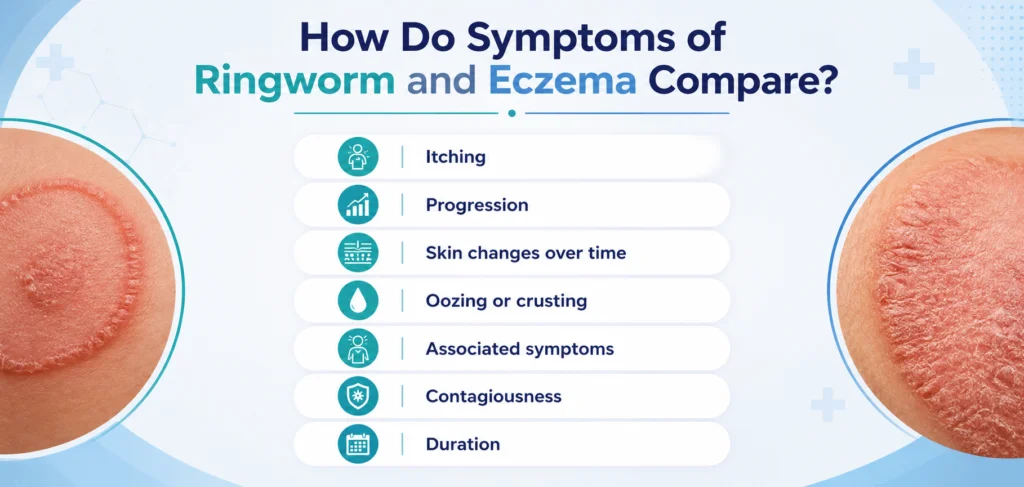
- Itching: Both are itchy, but ringworm itching is usually concentrated right at the ring’s border, while eczema itching is often intense and widespread, sometimes disrupting sleep.
- Progression: Ringworm tends to appear as one or two isolated rings that slowly expand over one to two weeks. Eczema often waxes and wanes over months or years, flaring with triggers and calming down between episodes.
- Skin changes over time: Untreated ringworm keeps expanding outward. Untreated or chronic eczema tends to thicken the skin (a process called lichenification) from repeated scratching.
- Oozing or crusting: Ringworm can develop small blisters or pustules along the active border. Eczema can ooze and crust during a severe flare, particularly if the skin becomes infected from scratching.
- Associated symptoms: Eczema often comes with generally dry skin elsewhere on the body and a personal history of allergies. Ringworm is usually isolated to the exposed patch with otherwise normal surrounding skin.
- Contagiousness: Ringworm can spread to other people, pets, or other parts of your own body through contact. Eczema cannot be passed to anyone else, no matter how close the contact.
- Duration: Untreated ringworm doesn’t resolve on its own; it typically requires antifungal treatment to fully clear, though it usually responds within a few weeks once treated correctly. Eczema is a lifelong tendency, meaning even well-managed skin can flare again later, usually with a trigger like weather change, stress, or a new soap or detergent.
If a rash is spreading to housemates, pets, or teammates, that’s a strong signal you’re dealing with ringworm rather than eczema, and it’s worth getting treated quickly to stop the spread.
How Are Ringworm and Eczema Treated?
Treatment is where getting the diagnosis right really pays off, since the two conditions are treated in almost opposite ways.
Treating Ringworm
- Confirm the diagnosis. A provider can often identify ringworm by sight or with a quick skin scraping viewed under a microscope.
- Apply topical antifungal cream (such as clotrimazole or terbinafine) to the affected area for the full course, typically two to four weeks, even after it looks better.
- Use prescription oral antifungal medication for stubborn cases, scalp ringworm, or infections covering a large area.
- Wash bedding, towels, and clothing in hot water, and avoid sharing personal items until the rash clears.
- Treat pets if they’re the likely source, since animals can carry ringworm without obvious symptoms.
- “If a fungal skin infection spreads to the skin around the nails, it can lead to a painful nail infection that needs its own targeted treatment.
Treating Eczema
- Moisturize consistently with a thick, fragrance-free cream or ointment, ideally applied within minutes of bathing to lock in moisture.
- Identify and avoid personal triggers, whether that’s a fabric, soap, food, or environmental factor.
- Use topical corticosteroids or non-steroidal anti-inflammatory creams during flares, as prescribed by a provider.
- Take short, lukewarm (not hot) showers, and pat skin dry instead of rubbing. Consider antihistamines or prescription options for more persistent or severe eczema, guided by a physician.
When to See a Provider in Spring, TX
Ringworm and eczema can look nearly identical on the surface, but they come from entirely different causes and need entirely different treatments. If your rash isn’t responding to what you’ve tried, is spreading, or you’re simply not sure what you’re looking at, it’s worth having it checked rather than guessing.
The team at Fattah Primary Care offers same-day and next-day skin rash evaluations at our Spring, TX clinic, with unhurried 20-30 minute visits where a provider examines the rash, confirms the diagnosis, and sends the right treatment straight to your pharmacy. No long waits, no guesswork, just a clear plan for clearer skin.
Bottom Line
Ringworm and eczema can look like near-twins at a glance, but they come from completely different causes and need completely different treatments. One is a contagious fungal infection that needs an antifungal to clear, and the other is a chronic immune condition that needs moisturizing, trigger management, and sometimes anti-inflammatory care.
Guessing wrong means weeks of treating the wrong problem while the actual rash keeps spreading or flaring. If a patch isn’t improving, keeps growing, or you’re simply not sure what you’re looking at, the fastest path to clear skin is having a provider take a direct look rather than relying on a mirror and a search engine.
FAQs
Q1.Is eczema genetic?
Yes, eczema can run in families. People with a family history of eczema, asthma, or allergies are more likely to develop the condition.
Q2.Can ringworm or eczema look like psoriasis?
Yes, both can resemble psoriasis because they may cause red, scaly patches. A healthcare provider can diagnose the condition based on the rash’s appearance and, if needed, additional testing.
Q3. Can ringworm go away by itself?
Some mild cases may improve over time, but ringworm usually requires antifungal treatment to clear the infection completely and prevent it from spreading.
Q4.What other circular rashes can look like ringworm?
Conditions such as nummular eczema, pityriasis rosea, granuloma annulare, and Lyme disease rash can all resemble ringworm and may require a medical evaluation.
Q5.How can I tell if my rash is ringworm or eczema?
Ringworm typically has a circular shape with a raised, scaly border and may spread outward, while eczema often causes dry, itchy patches without a distinct ring. If you’re unsure, consult a healthcare provider for an accurate diagnosis